An eighteenth-century army never marched alone. Behind the ordered ranks stretched another host: wagons and pack animals, drivers and sutlers, craftsmen, servants, wives and children, laundresses, nurses by necessity, sex workers, and people who belonged to no official roll at all. It was less a tail than a moving town—and without it the army could neither eat, repair itself, nor care for its sick.
The century between the Seven Years’ War and the end of the American Civil War did not simply sweep that population away. It rearranged it. Roads, permanent transport corps, steamships and railways moved more of the work away from the marching column and into depots, stations, hospitals and base towns. The immediate entourage could become smaller and more regulated even while the total number of people sustaining war grew.
01 · 1756
The moving city
“Baggage” meant far more than officers’ trunks. The train carried tents, tools, papers, field equipment, reserve ammunition, medical chests and part of the army’s food. Draft horses, oxen and pack animals carried the load—but also consumed it. Fodder was bulky, local supply uncertain, and every extra wagon required another team, driver and place in the column.
By 1756 European states already maintained magazines, commissaries and contracted deliveries. The Seven Years’ War was not supplied by random foraging alone. Yet the decisive last stage remained animal-powered. Rain could dissolve a road; a broken bridge could arrest thousands of men; enemy cavalry could turn a supply convoy into a battlefield. Campaign plans therefore followed navigable rivers, defensible roads and chains of magazines as surely as they followed strategic ambition.
The official train attracted an unofficial economy. Sutlers and vivandiers sold bread, drink, tobacco and small necessities. Smiths, wheelwrights and saddlers repaired the means of movement. Wives and other women cooked, laundered and nursed. Children, servants and displaced people found work or protection around the camp. Prostitution appeared despite repeated attempts to expel or regulate it. Commanders complained that followers delayed movement and consumed provisions; soldiers depended on many of the services they provided.
The follower was both burden and infrastructure: condemned in orders, required in practice.
Context: John A. Lynn’s study of women attached to early modern armies warns against reducing all female followers to prostitutes; many performed recognisable military-economic work. Holly A. Mayer makes the same point for the Continental Army: “belonging to the army” could describe a functional community larger than the enlisted force.
02 · Market & magazine
What the army issued—and what it could not
When an army halted, a market might gather at its edge. Local farmers, licensed sellers and opportunistic traders offered food, alcohol, fodder and household goods. These markets were flexible, but they were not reliable logistics. Prices rose with scarcity. Sellers fled danger. Local stocks could be hidden, exhausted or destroyed. Currency might be refused. The presence of money did not guarantee the presence of bread.
The soldier therefore lived inside a mixed economy: official ration, private purchase, help from family, requisition, foraging and sometimes plunder. The balance changed from campaign to campaign. A functioning state magazine could feed an army predictably; a failed convoy could throw it back upon the countryside overnight.
03 · 1792–1815
Speed, requisition and a military train
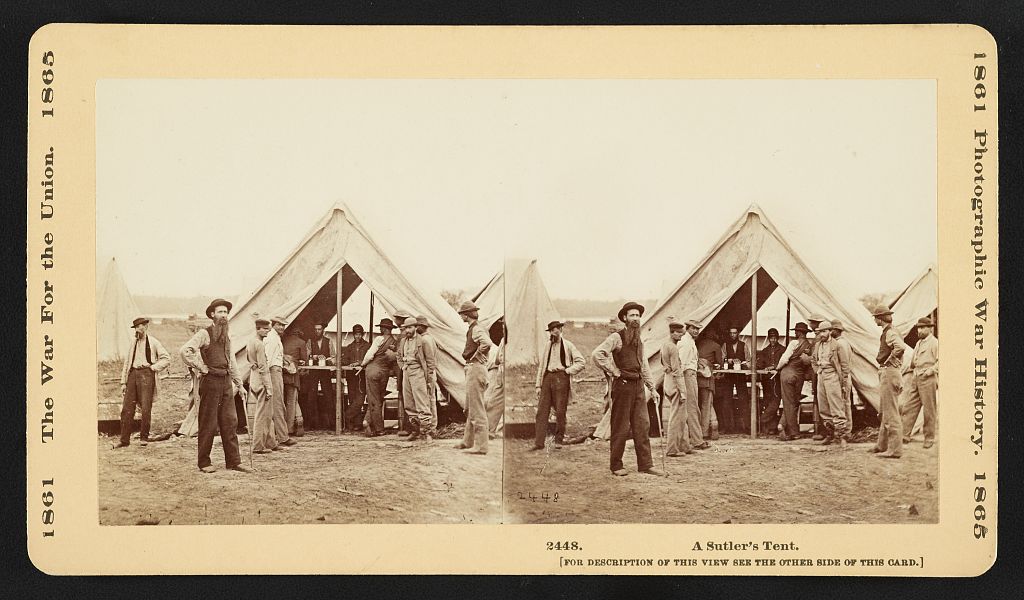
The Revolutionary and Napoleonic wars put far larger forces into motion. French armies often gained operational speed by dividing into corps, moving on several roads and drawing heavily on the country through purchase, levy and requisition. That did not mean Napoleon had abolished logistics or that every soldier simply “lived off the land.” Artillery, ammunition, medical stores and reserve food still demanded vehicles; poor, hostile or devastated regions could not sustain concentrated forces.
The significant change was administrative as well as tactical. In 1807 Napoleon created the Train des équipages militaires, bringing a crucial portion of army transport under military organisation instead of leaving it wholly to civilian contractors. The same impulse reached camp commerce: cantinières and vivandières could be attached to units and subjected to rules. Informal labour was being counted, licensed and—in selected functions—militarised.
The retreat from Moscow in 1812 exposed the limit. Fast marching and dispersed requisition could work where roads, population and supplies remained available. Distance, destroyed resources, cold and mass animal mortality could collapse the system. Mobility was not independence from supply; it was another way of arranging dependence.
Interlude · 1779–1780
When the market would not feed the army
The Continental Army’s winter at Morristown belongs slightly earlier in the chronology, but it makes the old system visible at human scale. Snow blocked roads, wagon movement failed, public credit had collapsed and nearby farmers resisted selling for depreciated paper currency. Food could exist in the region while soldiers went without it. Washington eventually resorted to organised requisition.
The crisis was not merely “no food.” It was a broken connection among producer, currency, road, wagon, authority and camp. A modern supply chain is precisely the attempt to keep those links operating continuously rather than waiting for a market to assemble beside hungry men.
Four Days, Four Nights
Bloody Hopes’ ballad places the listener inside the hungry winter of 1780: four breadless days, blocked wagons and men reduced to bark. It is the emotional case study for the structural failure described here.
Watch the video ↗04 · 1815–1854
The road becomes a system
Improved surfaces, bridges, postal roads and more centralised administrations did not eliminate wagons. They made wagon movement more calculable. Convoys could be separated from combat formations; magazines could be staggered; timetables and ration scales could replace some of the improvisation. The rear area began to emerge as a distinct military space.
Steam intensified the change. Ships moved bulk supplies between ports with a speed and regularity sail could not promise. Railways then carried loads inland without feeding thousands of draft animals along the entire route. Neither reached the individual battalion by itself. The new pattern was layered:
This was the shift from proximity to continuity. The seller no longer had to stand beside the regiment if a scheduled system could deliver what the regiment required. Civilian labour did not vanish: railwaymen, dockers, warehouse clerks, contractors and construction workers multiplied farther back.
05 · The other supply line
From surgeon’s chest to medical chain
At the beginning of this period armies already employed physicians and surgeons, but their work was fragmented. The physician treated internal disease; the surgeon dealt with wounds, fractures and amputations. Sick and wounded men might be carried by comrades, musicians, servants or whatever vehicle could be found. Churches, barns and houses became hospitals. Women washed linen, cooked and watched patients, often without formal status or training.
During the Revolutionary and Napoleonic wars, the French surgeon Dominique-Jean Larrey helped turn evacuation into a planned operation. His light ambulances volantes were intended to collect wounded men rapidly and connect forward treatment to hospitals behind the line. The importance was organisational: transport, triage and treatment were beginning to be conceived as successive stages rather than unrelated acts.
Roads, steamships and railways made the chain longer and potentially faster. The same vehicle that carried food and ammunition forward could carry sick and wounded men back. Medical care was becoming a logistics problem as much as a surgical one: patients, clean water, food, bandages, ventilation, records and trained labour all had to reach the right place.
06 · 1854–1856
Crimea: modern transport, broken delivery
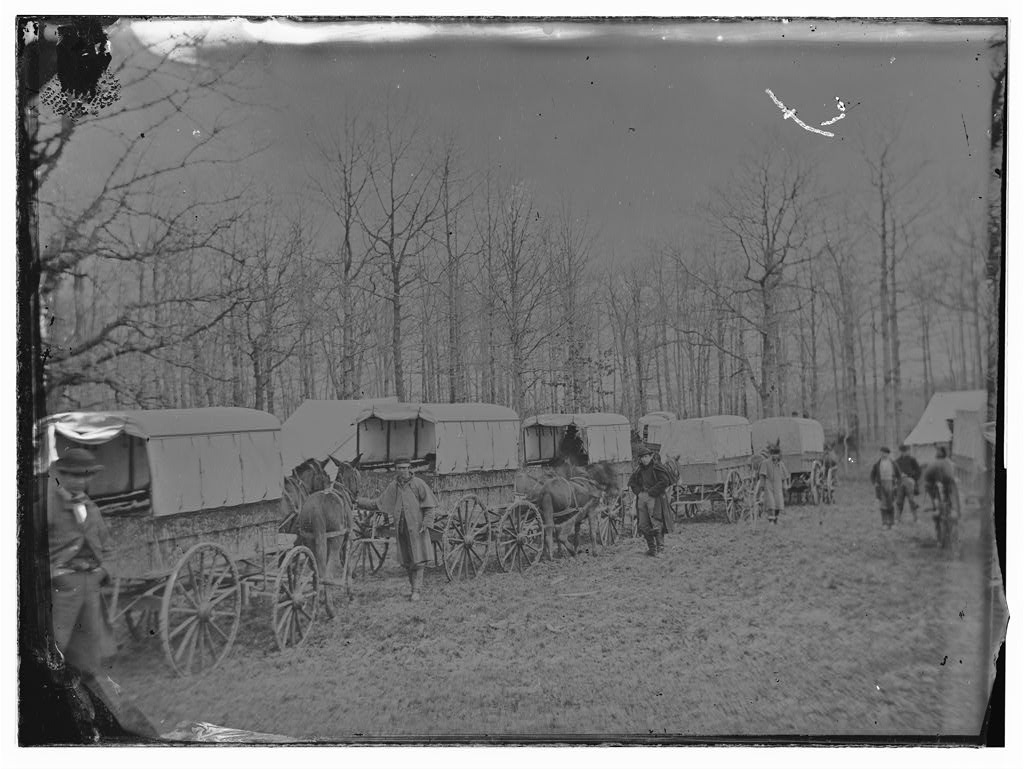
The Crimean War exposed the distance between possessing modern technology and organising it. Steamships brought British supplies to Balaklava, yet the short road to the siege lines became a morass. Transport animals died from cold and lack of fodder. Stores accumulated near the harbour while troops above Sevastopol lacked food, clothing, fuel and medical material.
The response included a Land Transport Corps and the Grand Crimean Central Railway from Balaklava. Rail did not cure every failure, but it demonstrated that bulk supply could be moved from port to an advanced base without an equivalent procession of starving animals. The scandal also made military administration itself a public subject.
Medicine underwent the same scrutiny. Florence Nightingale’s party of nurses at Scutari was not the only female nursing presence—religious sisters and other nurses also served—but it became the most influential symbol of organised nursing. The deeper change lay in treating sanitation, ventilation, diet, laundry, records and ward discipline as components of survival. Nursing was slowly separating from the anonymous domestic labour of camp followers and becoming a recognised occupation within an institutional hospital.
The National Army Museum identifies the unmetalled Balaklava road, transport collapse, creation of the Land Transport Corps and railway construction as linked responses. Nightingale’s own 1858 analysis, Notes on Matters Affecting the Health, Efficiency and Hospital Administration of the British Army, treated military health statistically and administratively—not simply as heroic bedside care.
07 · 1861–1865
The network reaches industrial scale
The American Civil War combined old and new transport on an unprecedented scale. Railways and steamboats moved men and bulk freight between strategic bases; enormous wagon trains still carried the final miles. Rail reduced the radius that animals had to cover. It did not abolish the mule.
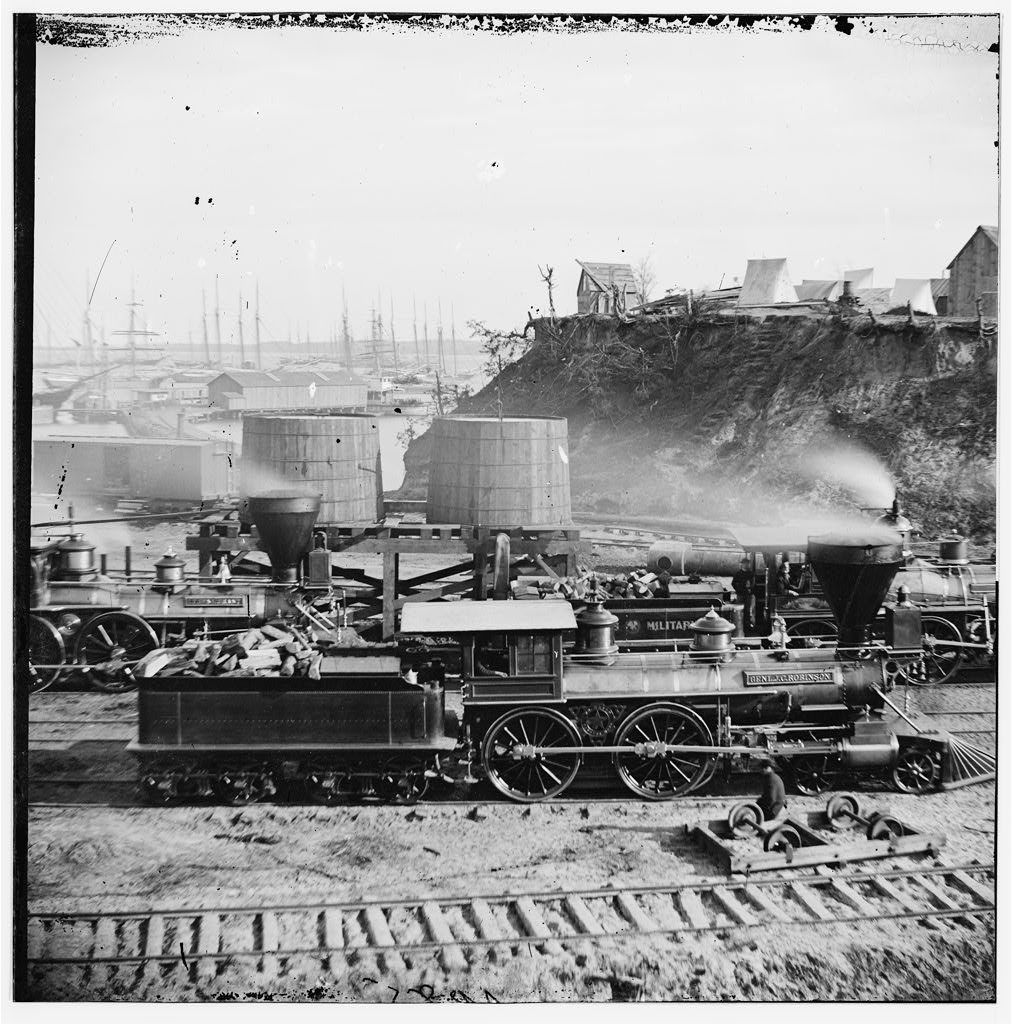
The Union created centralised military railroad management, construction crews and operating schedules. During the Atlanta campaign, rail carried supplies through Louisville, Nashville and Chattanooga toward advanced depots, from which divisional wagons distributed them. Around Petersburg, City Point joined deep-water shipping, warehouses, workshops, hospital facilities and a military railway into a single base. The U.S. Army Quartermaster Museum estimates that rail movement there reduced the wagon requirement by about half—roughly 5,000 wagons.
The sutler remains
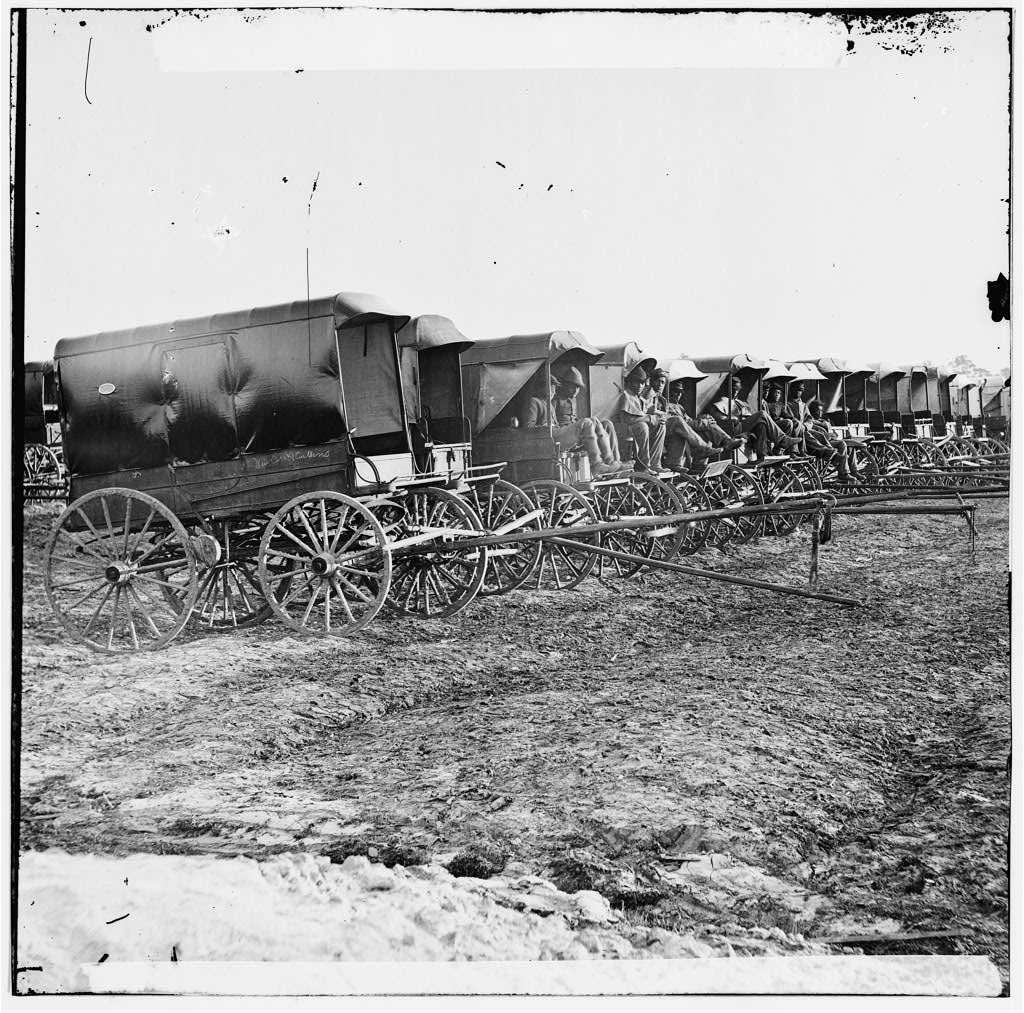
Private traders did not disappear. Union sutlers, formally appointed under wartime regulation, sold approved goods to soldiers. They supplied choice food, stationery, tobacco and comforts beyond the ration. Around bases and garrisons, lodging, drink, gambling and sex work continued to follow military wages. The key distinction was that these markets increasingly supplemented a public supply apparatus instead of standing in for its absence.
The medical team appears
Mass casualties forced medicine into a clearer division of labour. Surgeons, assistant surgeons, hospital stewards, nurses, cooks, stretcher bearers, ambulance drivers and quartermasters had to operate together. In the Army of the Potomac, Jonathan Letterman’s reforms from 1862 organised ambulances into a corps and connected battlefield collection, dressing stations, field hospitals and evacuation. The achievement was not a miraculous cure—the germ theory had not yet remade surgery—but a system that made responsibility visible.
Thousands of women served in Union and Confederate hospitals, through military appointment, religious orders and voluntary networks. The U.S. Sanitary Commission inspected conditions and channelled civilian donations. Black workers, freedpeople and refugees performed essential labour in camps, hospitals, laundries, kitchens, depots and on wharves. The “crowd behind the army” had not become less human. It had become larger, more specialised and distributed along a continental network.
08 · Final comparison
1756 and 1865, side by side
There is no honest single ratio of “civilians per soldier” for the entire century. Eighteenth-century returns counted soldiers with some precision but often omitted merchants, casual drivers, sex workers, unlicensed women and children. Civil War records counted official transport and medical personnel far better, while still missing much Black, refugee and informal labour. The comparison below therefore separates documented numbers from what remained uncounted.
| Measure | Beginning of period: regulated 18th-century model | End of period: Union field armies, 1864–65 | What changed |
|---|---|---|---|
| Military scale | 100 soldiers as the useful unitSupport was organised around regiment, company, magazine and an animal train whose size changed with the campaign. | Army of the Potomac: ≈120,000 soldiersAt the opening of the Overland Campaign in May 1864, one field army could be supplied as a single operational system. | The support problem moved from regimental community to army-wide network. |
| Women & family | British allowance: about 6 wives per 100 soldiersThey could draw rations and transport; children and unauthorised followers came in addition. Other armies and theatres varied widely. | No equivalent marching-family ratioWomen remained as nurses, laundresses, cooks, servants and refugees, but were increasingly concentrated in hospitals, bases and garrison towns rather than formally carried with every company. | From rationed regimental wives to specialised or spatially separated labour. |
| Total support people | Unknown—and inherently fluidLicensed women were only the visible minimum. Drivers, traders, craftsmen, servants, children and sex workers were incompletely or never mustered. | Atlanta campaign: ≈25,000 non-combatants for 99,000 campaign troopsAn often-cited estimate—about 25 support people per 100 soldiers—including railway crews, repairmen, teamsters, medical staff and Black camp servants; not all were civilians. | The support population did not shrink; it became specialised and more countable. |
| Wheeled transport | Four-horse commissariat wagon: ≈980 kg payloadA Prussian company bread wagon carried roughly 760 kg. Roads and fodder tightly limited reach. | 4,300 wagons for ≈120,000 menAbout 1 wagon per 28 soldiers in the Army of the Potomac, plus 835 ambulances. A six-mule escort wagon could carry about 1,365 kg on dirt roads. | Payload rose, but the decisive gain came from rail delivering closer to the army. |
| Animals | At least 4 draft horses per standard supply wagonThe animals consumed part of the freight and multiplied the follower problem. | 56,499 horses and mulesfor the Army of the Potomac’s ≈120,000 men—about 47 animals per 100 soldiers. | 1865 was not post-animal: rail shortened animal haulage rather than replacing it. |
| Medical transport | No permanent ambulance ratioRegimental surgeons existed, but collection depended heavily on comrades, musicians, servants and improvised vehicles. | ≈600–835 ambulances; 1,300+ trained enlisted personnelThe Army of the Potomac’s corps was supervised by roughly 40–60 nonmedical officers; the exact count changed during the campaign. | Evacuation became an assigned service with vehicles, personnel and command. |
| Strategic rear | Magazine → wagon → regimentThe moving train had to bridge most of the distance between stored food and soldier. | City Point: 600,000 tons moved by railThe depot supported more than 100,000 troops and 65,000 animals; rail reportedly replaced about 5,000 wagons, cutting the requirement roughly in half. | Thousands of workers and vehicles moved off the road and into a port–rail–depot complex. |
How to read these figures. The 1864 Army of the Potomac figures are a coherent snapshot reported by its chief quartermaster; they are not totals for every person working along the Atlantic supply network. The Atlanta figure is broader but mixes uniformed non-combatants with civilians. The “six wives per hundred” is a British regulated allowance, not a census of all eighteenth-century European followers. Juxtaposing them measures the change in organisation and record-keeping; it does not pretend that unlike categories are identical.
Normalised to 100 soldiers, the contrast is sharper: the eighteenth-century British establishment visibly acknowledged about six rationed wives, while leaving much of the surrounding civilian economy uncounted. In 1864, an American field army could document roughly 3.6 supply wagons, 0.7 ambulances and 47 transport or cavalry animals per 100 soldiers, while a separate campaign estimate placed its wider support population at about 25 per 100. The human tail was not necessarily smaller. Its functions had been divided, disciplined and pushed down the line.
09 · The century’s answer
What actually disappeared?
By 1865 an army could look leaner immediately behind its colours. More functions were regulated; fewer unauthorised people might be permitted in the marching column; supply could arrive from depots beyond the horizon; wounded men could be passed back through an organised chain.
But war had not become less dependent on civilians. It depended on more of them: factory workers, farmers, railway employees, dockers, clerks, contractors, nurses, laundresses and labourers. What diminished was not the human mass but its proximity. The camp follower became the rear-area worker. The spontaneous market became the scheduled depot. The woman nursing beside a wagon became, slowly and incompletely, part of a hospital staff.
The railway did not remove the crowd behind the army. It stretched that crowd across a continent.
The wagon and mule remained indispensable in 1865. The transformation was that they were no longer the entire system. They were its final link. Between 1756 and 1865, military modernity was built not only by new weapons at the front, but by making food, medicine and human labour arrive continuously from farther away.
Sources and further reading
Numbers and institutional “firsts” in logistics are often dependent on army, theatre and definition. This article therefore treats change as uneven: older practices survived beside newer systems.
- John A. Lynn, Women, Armies, and Warfare in Early Modern Europe (Cambridge University Press, 2008) — women’s work, camp communities and the limits of the “camp follower” label.
- Holly A. Mayer, Belonging to the Army: Camp Followers and Community during the American Revolution (University of South Carolina Press, 1996) — the Continental Army as a social and economic community.
- Martin van Creveld, Supplying War: Logistics from Wallenstein to Patton, 2nd ed. (Cambridge University Press, 2004) — the long operational history of supply.
- John A. Lynn, ed., Feeding Mars: Logistics in Western Warfare from the Middle Ages to the Present (Westview Press, 1993) — magazines, requisition and the relationship between supply and strategy.
- Christopher Duffy, The Military Experience in the Age of Reason (Routledge, 1987) — eighteenth-century armies, campaigning and lived experience.
- Rafe Blaufarb, “The French Army, 1750–1820,” in Frederick C. Schneid, ed., European Armies of the French Revolution, 1789–1802 (University of Oklahoma Press, 2015), and primary regulations on the French military train — for the shift toward militarised transport.
- Dominique-Jean Larrey, Memoirs of Military Surgery (English trans., 1814) — a primary account of mobile ambulances and Napoleonic surgical practice.
- Florence Nightingale, Notes on Matters Affecting the Health, Efficiency, and Hospital Administration of the British Army (1858) — sanitation, mortality and hospital administration as a system.
- National Army Museum, “Crimean War” — Balaklava road, transport crisis, Land Transport Corps and railway.
- Jonathan Letterman, Medical Recollections of the Army of the Potomac (1870) — the Union ambulance and field-hospital system in the author’s own account.
- Mary C. Gillett, The Army Medical Department, 1818–1865 (U.S. Army Center of Military History, 1987) — institutional medical history through the Civil War.
- Edward Hagerman, The American Civil War and the Origins of Modern Warfare (Indiana University Press, 1988) — staff work, rail, entrenchment and the operational system.
- Rufus Ingalls, Army of the Potomac transportation returns and circulars, 1863–64, reproduced in Rodney Lackey, Notes on Civil War Logistics — allowances and the 1864 wagon-train figures.
- Mary C. Gillett, U.S. Army Medical Department history, chapter 11 — 1864 Army of the Potomac ambulance personnel and vehicles.
- John A. Lynn, Women, Armies, and Warfare, and Charles J. Esdaile, work on British camp followers — for the British allowance of roughly six wives per hundred men and the warning that authorised wives were not the whole following population.
- J. P. Delaney, “The Development of Military Transport,” British Journal for Military History — comparative wagon payloads from Frederick’s commissariat vehicles to the U.S. escort wagon.
- U.S. Army Transportation Corps, “Use of Rail in Theaters of Operation” — wagon radius, military railroad organisation and Civil War rail operations.
- U.S. Army Quartermaster Museum, “City Point” and “Supplying Hell: The Campaign for Atlanta” — depot, rail and wagon integration.
- All four photographs reproduced above are from the Library of Congress Prints and Photographs Division; each catalogue record states “no known restrictions on publication.”
Companion listening: Four Days, Four Nights — The Hungry Winter of 1780. Discussion and source corrections are open at The Campfire.