Cavalry Weapons: From Lance to Repeater
Cavalry did not simply become obsolete when gunpowder arrived. It changed weapons, horses, armour and even the meaning of mounted combat. For five centuries horsemen argued—with lances, pistols, sabres and carbines—over whether mobility should end in shock, fire, or a man dismounting behind a wall.
Research and editorial review: Re Fagiano · Last revised September 1, 2026
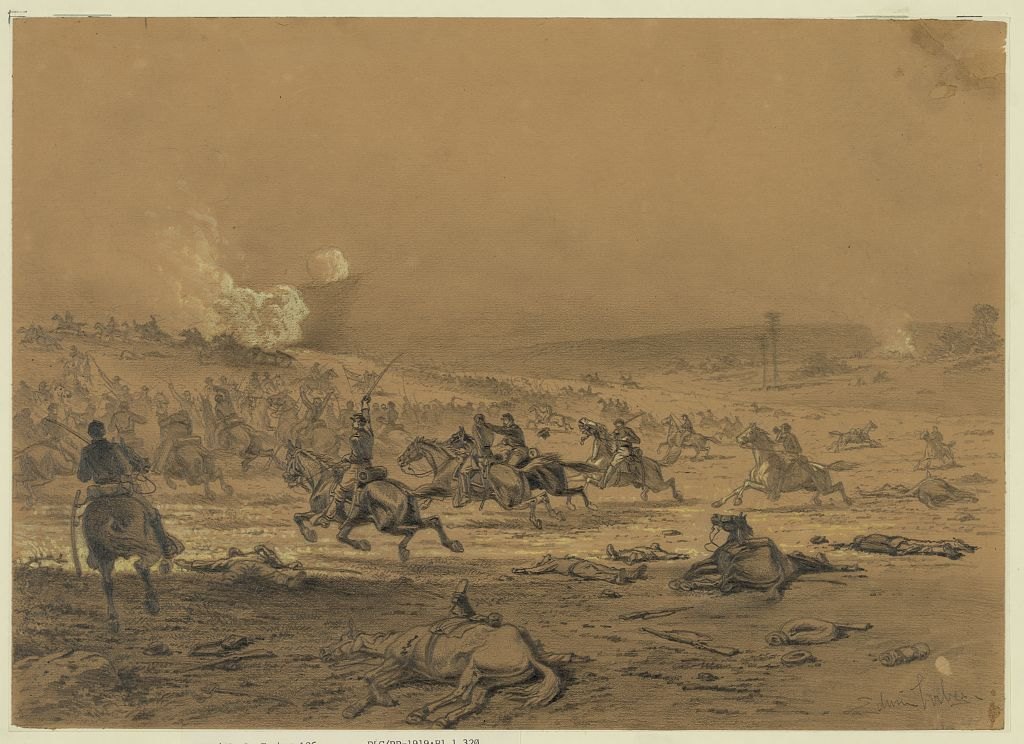
Edwin Forbes, A Cavalry Charge, 1861–76 · Library of Congress · No known restrictions
1. Before the Pistol: Medieval Cavalry Was Already More Than a Knight
The popular silhouette is simple: an armoured knight lowers a couched lance and turns horse and rider into one projectile. The technique was real, especially from the eleventh century onward, but it never described every mounted soldier or every mounted fight.
- Shock required a system. A charge was not the isolated feat of a heroic rider. It required horses conditioned to noise and contact, men able to keep alignment, ground firm enough to carry them, and an enemy whose order could be broken. Against ditches, stakes, disciplined spearmen or terrain that dissolved formation, the expensive arm lost its advantage.
- Armour and horse were social technologies. The heavy horseman concentrated wealth: horseflesh, harness, armour, retainers and years of practice. That made him tactically powerful and politically important, but also difficult to replace.
- Mounted archers and crossbowmen complicate the picture. Across Europe and the Mediterranean, horsemen carried bows, crossbows and javelins. Mounted crossbowmen often used the horse for operational mobility and dismounted to span and fire; others shot from the saddle when equipment and circumstances allowed. They were not failed knights. They solved a different problem: arriving quickly, screening, harassing and holding ground without committing to collision.
- Infantry never disappeared. Bannockburn in 1314, Courtrai in 1302 and the Swiss victories of the fifteenth century did not prove that cavalry had become useless. They proved that shock failed when disciplined foot soldiers controlled ground and preserved cohesion.
The first lesson of cavalry history is therefore also the last: mobility is certain; shock is conditional.
2. The Eastern School: Hussars, Croats, Stradioti—and Venice
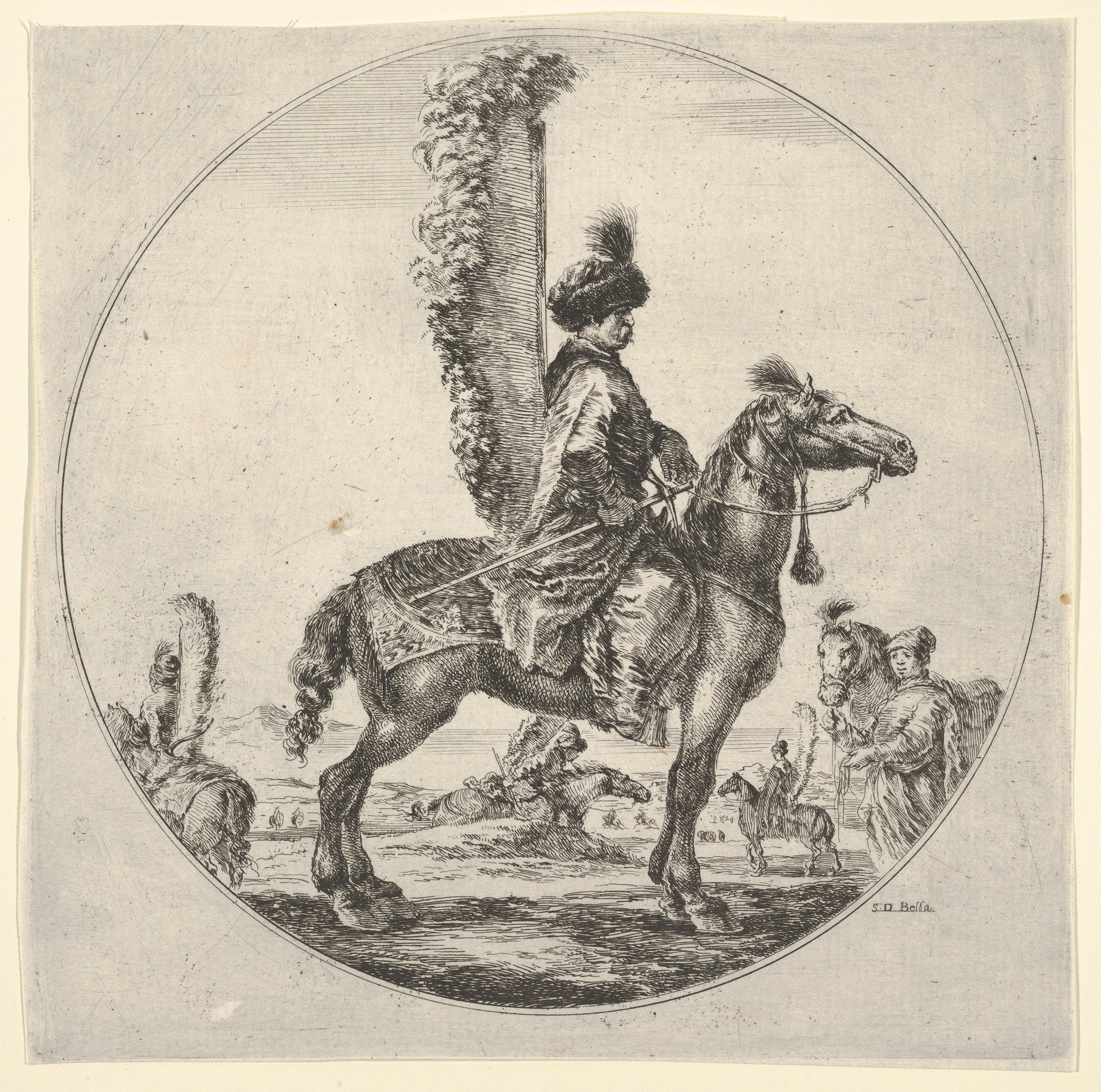
Western European armies often learned light cavalry from frontiers where raiding, reconnaissance and irregular war were ordinary. Hungary, Croatia, the Balkans and the Venetian maritime state were not peripheral to cavalry's development. They were laboratories.
- Hungarian hussars. The hussar emerged in the late medieval and early modern Hungarian world as a lightly equipped horseman suited to scouting, ambush, raiding and pursuit. The name and style spread west until every major eighteenth-century army wanted hussars—even when the uniforms became more theatrical than the frontier origins.
- Croatian horse. Croatian and Hungarian light cavalry served Habsburg and Spanish armies across Europe. In the Thirty Years' War and beyond, their reputation rested on living off difficult country, screening an army, attacking communications and appearing where slower cavalry could not.
- Venice as an importer of frontiers. The Republic recruited stradioti from its Greek, Albanian and South Slav possessions, particularly the Morea and the eastern Adriatic. These mercenary light horsemen fought in Venice's Italian wars and were soon copied or hired by France, Spain, England and the Empire.
- Not miniature men-at-arms. Stradioti used speed, dispersed formations, surprise and local intelligence. Contemporary observers noticed unfamiliar weapons and dress, but their real novelty was operational: a force that could reconnoitre, raid, capture prisoners and forage far beyond the pace of heavy cavalry.
- Continuity under new names. As Venice's Greek possessions contracted, Dalmatian and Albanian recruitment became more prominent. Croati a cavallo and related formations carried frontier cavalry traditions into the seventeenth and eighteenth centuries.
Venice's role was not to invent light cavalry. It connected Balkan military labour to the Italian and western European market, turning a regional way of war into an international model.
Curiosity: Three Words That Rode West
- The cravat came with Croatian soldiers. Croatian cavalrymen in seventeenth-century French service wore knotted neckcloths that attracted Parisian attention. French cravate was formed from a version of Croate—“Croat”—and the soldier's practical scarf became European court fashion. The modern necktie is therefore a civilian descendant of a military marker, although the elegant lace cravat of Louis XIV's court was already far removed from the cloth worn on campaign.
- “Hussar” travelled with the military fashion. The Hungarian huszár entered western languages through the fame of Hungarian and Balkan light horse. A widely accepted etymological path connects it to a South Slavic word for raider or freebooter and ultimately to the same family as corsair. The attractive story that derives it from Hungarian húsz, “twenty,” because one horseman was raised for every twenty tenants, is old but disputed. By the eighteenth century the word had spread from a frontier troop type to hussar regiments in Prussian, French, Russian, British and other armies, complete with braided jackets, pelisses and increasingly theatrical uniforms.
- “Huzza!” is probably not a hussar's cry. The resemblance between hussar and English huzza or huzzah is tempting, but historical dictionaries do not establish a derivation. Huzza appears in English in the sixteenth century as a sailor's shout, perhaps associated with hauling or hoisting; hurrah developed later among several related European cries. The honest curiosity is the false friend: cavalry helped spread the word hussar, but the cheer has a separate and uncertain history.
3. Armour Meets the Wheellock: Cuirassiers and Schwarze Reiter
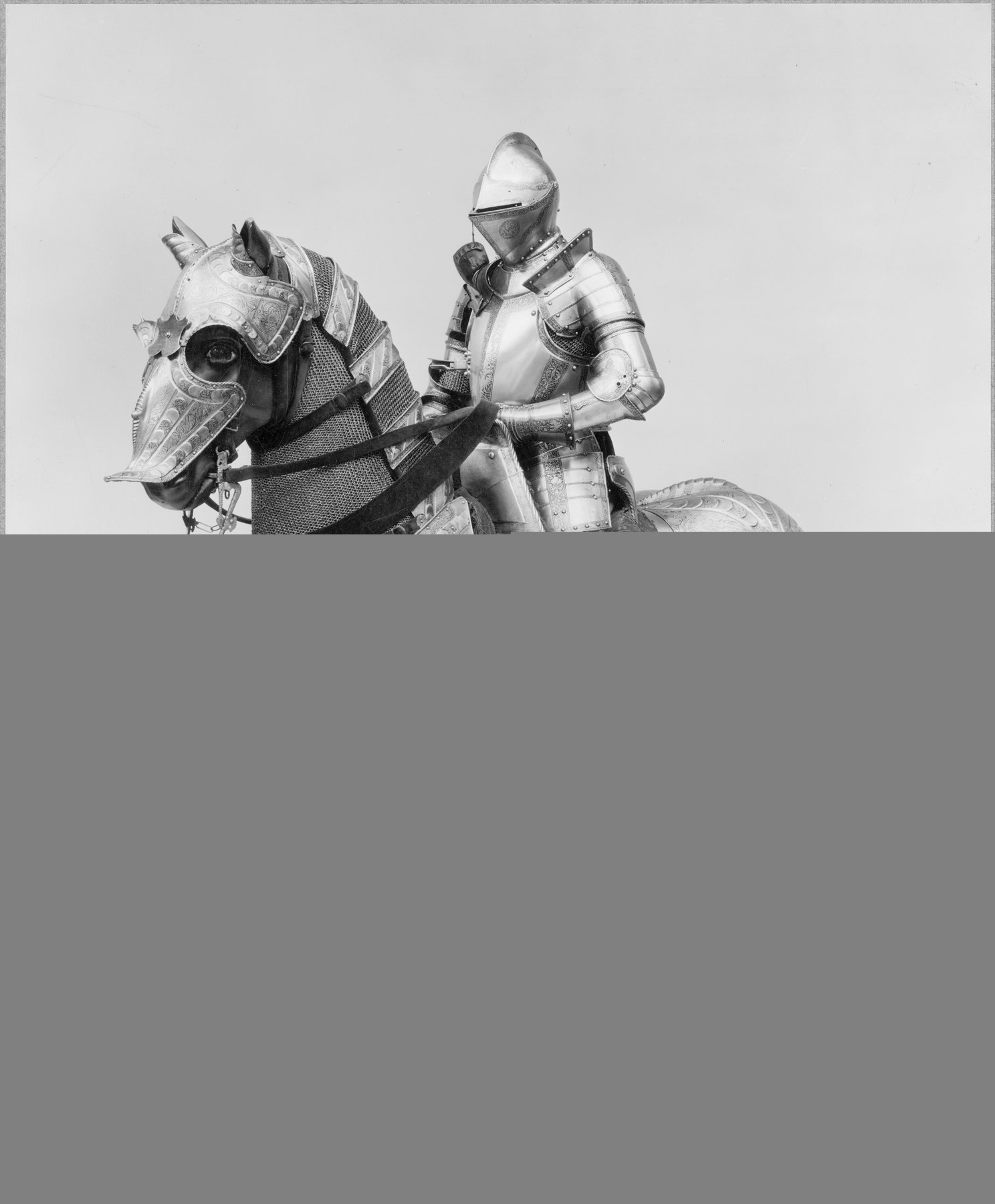
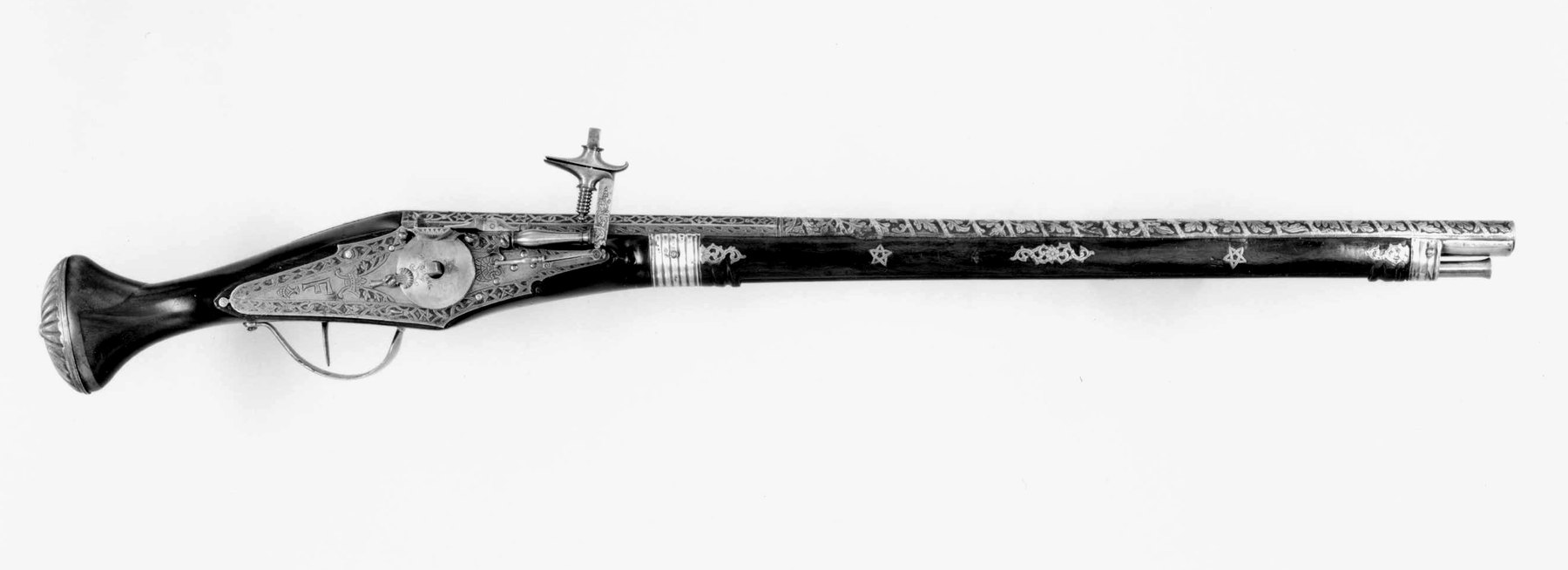
Gunpowder did not knock the rider from the saddle. The wheellock pistol, practical from the early sixteenth century, gave cavalry a firearm that could be carried ready without a burning match. The result was not one new cavalry type but several.
- The armoured lancer survives. Renaissance men-at-arms and gendarmes added plates as firearms improved. Their armour became more specialised, expensive and sometimes proofed by a pistol shot, while horse armour gradually declined.
- The cuirassier is a compromise. Full harness contracted toward helmet, breastplate and backplate. The cuirassier retained protection and shock potential but normally carried a sword and a pair of wheellock pistols instead of relying only on the lance.
- The German Reiter. Reiter simply means rider, but the term became associated with pistol-armed German mercenaries. The Schwarze Reiter—“black riders”—were named for darkened armour as well as a formidable reputation. Several pistols could be carried in saddle holsters and sometimes tucked into boots or belts.
- Fire at touching distance. A pistol was not automatically a long-range substitute for the lance. Many cavalrymen charged, reserved fire, and discharged at the last moment against an opponent's face or armour before drawing the sword. Fire and shock could belong to the same action.
4. The Caracole: Tactic, Label, and Convenient Villain
The caracole is usually described as ranks of cavalry approaching, firing pistols and wheeling away so the next ranks could fire while the first reloaded. That description is useful—and dangerous if made into the whole history of pistol cavalry.
- What it tried to solve. Dense pike formations were hazardous to charge. Repeated close pistol fire promised to disorder or thin them before swordsmen entered.
- What made it difficult. Smoke, nervous horses, short effective range and the choreography of deep formations could turn controlled rotation into confusion. Infantry firearms also put more barrels into the exchange than cavalry could sustain.
- It was never a single universal drill. Early modern writers used overlapping terms for countermarching, wheeling and pistol fire. Units mixed methods according to circumstance. Some “caracoles” ended in a charge; some pistol cavalry charged from the beginning.
- The morality play is too neat. Older histories made Gustavus Adolphus the man who abolished cowardly fire tactics and restored the brave sword charge. Swedish reforms did emphasise shallower formations, aggressive movement and close cooperation with infantry and artillery. But commanders before and after Gustavus combined pistol and sword; the change was gradual, not a single revelation.
The pistol did not replace shock. It forced cavalry to decide when shock should begin.
5. Lance, Pistol, or Sword? The Seventeenth- and Eighteenth-Century Argument
The debate was never only about which weapon killed best. It was about morale, formation and what cavalry was supposed to do after contact.
- The lance offered reach and cohesion. A levelled rank of points gave the first physical contact to the lancer and encouraged the unit to keep moving. Its disadvantages were awkwardness, training demands and limited usefulness once formation broke.
- The pistol penetrated armour and tempted hesitation. It allowed a rider to attack without accepting immediate collision, but firing too early could halt the charge and dissolve momentum. Fired late, it became a one-shot extension of shock.
- The sword simplified the final act. As armour and the lance declined in much of western Europe, straight swords and curved sabres became the principal weapons. The important reform was often not the blade but the order to remain knee-to-knee, hold fire and accelerate together.
- Eastern Europe preserved alternatives. Polish-Lithuanian hussars and later uhlans maintained lance traditions. Hungarian hussars kept light-cavalry practice alive. Their success repeatedly reminded western armies that no universal cavalry model existed.
- Frederick's answer was discipline. Prussian cavalry under leaders such as Friedrich Wilhelm von Seydlitz was trained to charge in ordered waves, reserve the final acceleration and rally for another attack. The tactical product was not merely “shock cavalry” but shock that could be repeated.
6. Dragoons: When the Horse Is Transport
Dragoons appeared in the sixteenth and seventeenth centuries as infantry who rode to battle and dismounted to use a firearm. Their name became attached to a spectrum rather than a fixed type.
- The original bargain. A cheaper horse and less specialised rider produced strategic mobility without the cost of elite cavalry. The dragoon could seize a bridge, reinforce an outpost or raid a village, then fight on foot with a musket or carbine.
- Mounted fire existed, but accuracy fought anatomy. Pistols and short carbines could be fired from horseback. A rider could shoot forward, sideways or during pursuit, but controlling horse, weapon, smoke and recoil made deliberate fire difficult. Effective mounted shooting tended to be close and situational.
- Dismounted fire traded speed for bodies. Horse-holders removed part of the unit from the firing line—often one man controlling several horses. Dragoons therefore put fewer muskets into action than the same number of infantry, but could put them somewhere infantry could not reach in time.
- Success changed the name. By the eighteenth century many dragoon regiments had become ordinary battle cavalry, charging with swords. “Dragoon” survived as a title even when the original mounted-infantry function had faded.
7. Shock Returns: The Napoleonic Cavalry System
By 1800 European armies had divided cavalry by job. Heavy cavalry attacked; light cavalry found and pursued; dragoons sat uneasily between. None worked alone.
- Heavy cavalry. Cuirassiers and carabiniers were concentrated as reserves. Their charge was most effective after artillery or infantry had shaken an enemy and created a flank or gap.
- Light cavalry. Hussars, chasseurs à cheval, Cossacks and similar troops provided reconnaissance, outposts, screens, raids and pursuit. These unglamorous duties often mattered more to a campaign than one famous charge.
- The lance returns. Polish uhlans demonstrated the weapon's value, and Napoleon expanded French lancer formations. Britain converted light dragoons into lancers after the wars. Reach mattered greatly in mounted combat and pursuit, less against steady infantry.
- Formed infantry remained the limit. A calm square with bayonets and controlled fire was extraordinarily difficult for cavalry to break. At Waterloo, repeated French charges produced spectacle without decision because the squares remained formed and the attacks lacked sufficient combined-arms support.
- The charge was a morale event. Horsemen did not routinely crash bodily through solid ranks. One side often checked, opened or fled before contact. The power of cavalry lay in making an already unstable formation believe that flight had become safer than standing.
“That Austerlitz Sun” shows cavalry exploitation after a combined-arms victory; “The Smile Inside the Square” is the same system seen from infantry that refused to break.
8. Balaclava: Not the Death of Cavalry, but a Warning
The Charge of the Light Brigade on 25 October 1854 is often treated as the moment modern firepower abolished cavalry. It was not. The charge followed a misunderstood order and ran along a valley exposed to guns on front and flanks. Its destruction demonstrated what artillery could do to horsemen sent against the wrong objective—not that every mounted action had become impossible.
- The same battle contained a successful charge. The Heavy Brigade attacked Russian cavalry uphill and drove it back. Tactical circumstances, not the calendar, separated success from disaster.
- Cavalry still had operational work. Screening, reconnaissance, raids and pursuit did not vanish because frontal charges grew more dangerous.
- Yet the warning was real. Rifled small arms and artillery enlarged the beaten zone a mounted formation had to cross. The old requirement—charge only when the enemy is disordered—became unforgiving.
9. Firing from the Saddle—and Fighting on Foot
The nineteenth century gave cavalry percussion ignition, rifled carbines, revolvers and finally metallic cartridges. The crucial change was not that horsemen could shoot. They had done that for centuries. It was that one rider could now deliver several reliable shots before an opponent closed.
- The percussion revolver. Samuel Colt's revolving pistols made five or six shots available without reloading. In close mounted combat, pursuit and irregular war, that changed the arithmetic. A revolver did not make accurate long-range fire from a moving horse easy; it made repeated close fire possible.
- Multiple pistols before multishot pistols. Earlier cavalrymen sometimes carried two, four or more single-shot pistols. The revolver reduced that burden and kept one familiar grip, trigger and sight line through successive shots.
- The carbine was the deeper revolution. A shortened shoulder arm was easier to manage around reins and saddle. Breech-loaders such as the Sharps could be reloaded while prone or kneeling; the muzzle-loader could not.
- Dismounting stabilised everything. Once on foot, a cavalryman gained cover, a supported firing position and deliberate aim. His horse became transport rather than weapon. The price remained horse-holders and fewer rifles in the line.
- Fire from horseback survived in niches. Revolvers were formidable in a melee and mounted carbines useful during skirmishing or pursuit. But the more accurate and longer-ranged the firearm became, the greater the advantage of stopping—or getting off the horse—to use it.
10. The Repeating-Carbine Turn: The American Civil War
American cavalry had vast distances to cover, few European social traditions to protect and an industrial firearms market ready to experiment. It became the clearest nineteenth-century example of cavalry transforming into a mobile fire arm.
- Revolvers shaped mounted combat. Colt and Remington percussion revolvers gave cavalrymen repeated close-range fire. They were especially valuable in the confused, individual combat of raids and pursuits.
- Sharps changed loading. The Model 1859 Sharps carbine was a durable single-shot breech-loader widely issued to Federal cavalry. A man could load and fire without standing to ram a cartridge down the muzzle.
- Spencer changed volume. Its buttstock magazine held seven metallic rimfire cartridges. The National Park Service records more than 90,000 Spencer carbines built, mostly for Federal cavalry, with a practical rate dramatically above single-shot arms.
- Buford at Gettysburg. On 1 July 1863, John Buford's cavalry fought dismounted west of Gettysburg, trading ground for time until Union infantry arrived. The horses delivered the men; terrain, carbines and disciplined withdrawal did the fighting.
- Mounted infantry completes the circle. Wilder's “Lightning Brigade” used horses for movement and Spencer rifles for combat. At that point the medieval mounted crossbowman's bargain had returned in industrial form: ride to the decisive ground, then become infantry with unusual mobility and firepower.
- The sabre did not disappear overnight. Brandy Station and later Shenandoah fighting still included mounted charges. Sheridan's cavalry could fight on foot with repeaters and mount for pursuit. The advantage was not choosing one identity; it was changing identity faster than the enemy.
11. After the Repeater: Magazine Rifles, Machine Guns, and Mounted Infantry
By the late nineteenth century, a horse and rider presented a large target to rifles that loaded rapidly, used self-contained cartridges and produced far less smoke. The machine gun intensified the problem, but the decline of shock cavalry began before it.
- Colonial wars preserved mobility. Across open country in Africa and Asia, mounted infantry could patrol, scout, raid and concentrate faster than foot soldiers. The Boer commandos showed the effectiveness of excellent horsemen who normally dismounted to fire modern magazine rifles.
- The lance remained on paper and parade. European armies retained lancers, cuirassiers and elaborate mounted doctrine into 1914. This was not pure irrationality: a European war was expected to become mobile after an initial clash, and cavalry remained the fastest reconnaissance arm before reliable radios and motor vehicles.
- Firepower moved into the cavalry unit. By 1914 British cavalry carried the Short Magazine Lee-Enfield and could fight on foot; units also received machine guns and support from horse artillery. The mounted arm had become a mixed package of reconnaissance, mobility and fire.
12. The Disappearance of the Decisive Charge
The First World War did not make horses disappear. It made the mounted mass charge an exceptional rather than decisive battlefield method.
- On the Western Front, the system closed. Rifles, machine guns, rapid artillery, barbed wire, trenches and shell-cratered ground attacked every requirement of shock cavalry at once: speed, cohesion, surprise and an open route to the target.
- Cavalry adapted again. British cavalry performed valuable reconnaissance in 1914 and fought repeated delaying actions both mounted and dismounted. At Ypres and Moreuil Wood, cavalrymen reinforced infantry lines and fought on foot. Mounted action remained possible when movement and surprise returned.
- Other theatres were different. In Palestine and other open theatres, mounted troops and cavalry still exploited operational space. The weapon was not universally dead; the conditions for its old decisive role had migrated away from Europe's fortified fronts.
- Mechanisation inherited the verbs. Armoured cars and tanks took over reconnaissance, exploitation and shock. Modern “cavalry” formations retained the name because the mission survived after the horse ceased to be its platform.
The disappearance was therefore not one last doomed charge. It was a transfer of functions. Reconnaissance went to aircraft and armoured vehicles; shock went to tanks; mobile fire went to motorised and mechanised infantry. The cavalry arm survived by becoming everything except mounted collision.
13. What the Long History Actually Shows
- There was no straight line from lance to gun. Lances returned after pistols; armour survived firearms; sabres coexisted with repeaters; mounted and dismounted combat alternated for centuries.
- Heavy and light cavalry were answers to different questions. The cuirassier belonged to the battle's moment of decision. The hussar, Croat or stradiot belonged to the hours and miles that made a decision possible.
- The horse's most durable value was time. Cavalry saw first, arrived first, delayed pursuit, cut communications and converted defeat into destruction. Shock was spectacular; information and movement were routine.
- Firearms changed the best use of mobility. Once a dismounted rider could deliver rapid, accurate fire, carrying the man to the right ground became more valuable than carrying him into the enemy.
- Cavalry did not fail to evolve. It evolved repeatedly. What vanished was the battlefield that allowed one particular form—the massed mounted charge—to decide a war.
Sources and Further Reading
- Contemporary sources: François de La Noue, Discours politiques et militaires (1587); Lewis Edward Nolan, Cavalry: Its History and Tactics (1853); Philip St George Cooke, Cavalry Tactics (1862); George T. Denison, A History of the Cavalry … with Lessons for the Future (1877).
- John France, Western Warfare in the Age of the Crusades, 1000–1300 (1999), and Kelly DeVries, Medieval Military Technology (1992) — medieval shock, infantry and missile troops.
- Bert S. Hall, Weapons and Warfare in Renaissance Europe (1997) — gunpowder weapons, armour and the changing mounted arm.
- Clifford J. Rogers, ed., The Oxford Encyclopedia of Medieval Warfare and Military Technology (2010) — comparative reference on cavalry, crossbows and mounted warfare.
- Nicholas C. J. Pappas, “Stradioti: A Balkan Military Diaspora in Early Modern Europe,” in A Military History of the Mediterranean Sea (2022) — Venetian service and the international spread of Balkan light cavalry.
- Daniel Staberg, The Most Feared Horsemen of the Planet King: The Croatian-Hungarian Light Cavalry Regiments in the Army of Flanders (2025) — archival study of Croatian-Hungarian cavalry in Spanish service.
- Ministry of Foreign and European Affairs of Croatia, “Mozaik Kravata” — Croatian horsemen and the French name and fashion of the cravat.
- Oxford English Dictionary, entries for hussar, huzza and hurrah; New Hungarian Etymological Dictionary, “huszár” — competing etymologies and early attestations.
- David Parrott, Richelieu's Army: War, Government and Society in France, 1624–1642 (2001), and John A. Lynn, “Tactical Evolution in the French Army, 1560–1660” — lance, pistol and the danger of a simple caracole-to-shock narrative.
- Geoffrey Parker, The Military Revolution: Military Innovation and the Rise of the West, 1500–1800 (2nd ed., 1996) — early modern combined arms and military change.
- Christopher Duffy, The Military Experience in the Age of Reason (1987) — eighteenth-century cavalry, drill and battlefield experience.
- Rory Muir, Tactics and the Experience of Battle in the Age of Napoleon (1998), and Gunther E. Rothenberg, The Art of Warfare in the Age of Napoleon (1978).
- National Army Museum, “Cavalry Roles” — dragoons, lancers, carbines and the changing duties of cavalry.
- Metropolitan Museum of Art, Italian wheellock pistol — an object record connecting wheellock pistols with armoured cuirassiers.
- Stephen Z. Starr, The Union Cavalry in the Civil War, 3 vols. (1979–1985) — the American mounted arm's operational and tactical transformation.
- National Park Service, “Civil War Weapons in the Shenandoah Valley” — Sharps and Spencer carbine specifications and service.
- Smithsonian National Museum of American History, “Tools of War” — revolvers and cavalry firearms.
- David Kenyon, Horsemen in No Man's Land: British Cavalry and Trench Warfare, 1914–1918 (2011), and National Army Museum, “Cavalry on the Western Front” — mounted reconnaissance, dismounted fire and the limits of the charge.
This article is a companion piece to Bloody Hopes' historical war ballads. Discussion and source corrections are open at The Campfire.